Your shoes can tell you a lot…including whether you are landing harshly, and which type of shoe might be best for you.


Most people don’t know it, but the wear pattern on a well-used pair of running shoes can tell a pretty good story. That story may include the fact that you are over-striding and landing with more impact than you need to. It may also tell you that you should work on strengthening your feet, or that you have a leg length discrepancy. Often, runners go get a gait analysis at their local running store, not knowing that bringing a well-worn pair of shoes can likely tell the staff a whole lot more about what shoes will be best for you than watching or filming you run ever could. In fact, running store gait analysis for shoe selection can be misleading and/or down right wrong. About 50% of all running shoes sold at run specialty shops are so-called “Stability” shoes. However, only about 1 in 8 running shoe wear patterns show that a runner *might* need the so-called stability.
The first step to reading the wear pattern on your shoes is to get a well-used pair of running shoes that has only been used for running. If they have been used for too much walking, this will throw off the wear pattern and make it hard to truly get a good read on what’s going on with your run.
Step 1: Heel Wear, What it Means, and What to do About it
Now that you’ve got a suitable pair of shoes to read, it’s time to flip them over and look at the wear pattern on the rubber outsole. In my opinion, the most important thing you should look at is the heel area of each shoe. If your shoes show significant wear at the outside back corner, you are likely over-striding and landing with high impact that is hard on your shins, knees, hips, and low back long term. A study by Harvard scientists found that over-striding/excessive heel-striking produced three to five times more impact than runners who landed closer to underneath their knees and didn’t land with a harsh heel-strike. This type of landing also causes excess torque in the joints, which many scientists believe is actually even more of a cause of running injuries.
If your shoes show this type of wear, I recommend a few simple tips such as not letting the elbows swing forward past the hips and taking quicker steps. The easiest and quickest way to stop over-striding and optimize your form is to get and use a FloatRun Harness for a few weeks. Most distance runners have never had a running lesson, so having this “coach that comes with you every step of every run until great form becomes second nature” can be incredibly helpful. Additionally, finding a form coach or running store nearby that teaches a class could be very beneficial as well. For more on improving your form and optimizing your landing, check out the detailed information here.
Nearly all runners land on the outside part of their feet. Contrary to popular belief, landing on the outside does NOT mean you are over-pronating. It just means that you are normal. Shoes are wider than human heels, and hips are wider than where your shoes hit the ground. These two things make it so virtually every runner lands on the outside of their shoes.
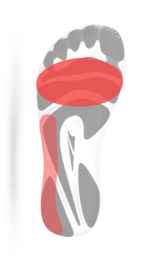
Neutral
Step 2: Forefoot Wear and What it Means
Now that we know that landing on the outside is normal, the next thing to look at is which part of the forefoot of the shoe has the most wear.
Neutral Wear
Your foot absorbs impact by rolling inward and then pushing off your strongest toe, which is your big toe. So, an ideal wear pattern will show the most wear on the forefoot in the middle to slightly inside part of the shoe. The running shoe world calls this “neutral.” If this is you, in most cases your body will not be compatible with “stability” shoes and shoes with any kind of dark material under the arch or shoes with any extra arch support or “control” features.
–
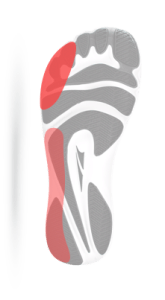
Supination
Supinated Wear
If wear is more towards the outside in the front half of the shoe, you aren’t pronating or absorbing shock very well, and you are a “supinator” over “under-pronator”, which is very rare…so much so that major running shoe companies don’t make supination specific shoes. With that said, under pronators or supinators will typically benefit from foot strengthening exercises, Correct Toes, and small amounts of barefoot running to teach the foot how to land lighter and to get the big toe involved in controlling and stabilizing throughout the stance.
One other point here is that it is *very* common to see wear outside/lateral of center on shoes that are built for pronation due to 2 factors. The first is running stores very commonly over-prescribe shoes to control pronation when they should not. The second is the combination of the shoe with a “supportive” insole or doctor-made orthotic pushes the foot out too far and doesn’t allow the foot to pronate naturally. Since pronation is so crucial to proper biomechanics and helping the body to absorb impact efficiently, this is a major problem for a lot of people.
–
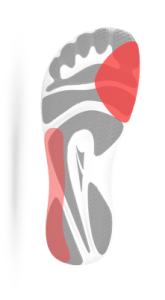
Pronated
Pronated Wear
If your wear is on the inside part of the forefoot, then you are likely an “over-pronator” meaning that your feet collapse more than usual, causing the leg to do the same and likely causing excess joint torque. For some, this is a bone deformity, collapsed arch, or genetic inheritance. For others, their feet are simply weak from a lifetime of wearing so-called “supportive” shoes and/or orthotics that move the foot out of its natural position and weaken the foot muscles.
What to do
Wear patterns like supination and excessive pronation are typically tied to weak foot musculature and poor foot alignment (Do your first three toes touch? They shouldn’t!). This means your “landing gear” isn’t able to absorb impact, stabilize, and control forces—which means these forces then get translated further up the kinetic chain instead…to your joints. Keep in mind that foot strengthening has been shown to reduce running injuries by 242%—statistically the single best way to reduce running injuries. Most people that “over-pronate” will absolutely benefit from a foot strengthening regimen that includes standing on one foot with the heel 1/2″ off the ground (build up to being able to hold this for 90 seconds) and/or running or walking short distances barefoot on soft surfaces. Correct Toes are a “natural orthotic” that spaces/aligns the toes and can also be a great benefit for strengthening the foot and helping to re-align it to its natural position. These naturally decrease excessive pronation instantly, increase blood flow and balance, and help the foot become more stable and better able to control forces long-term. In short, they have all the benefits (and more) of a traditional orthotic, without the bulk, foot weakening, and other downsides that typically come with orthotics.
Shoe Considerations
If your wear pattern shows that you are an over-pronator, you may be among the 1 in 8 people who may benefit from wearing a stability shoe until your feet re-align and get stronger. As long as your wear pattern continues to show wear on the inside of the forefoot, you may be a candidate for a stability shoe. However, it is important to note that outside of a weak link to shin splints, excessive pronation has never been significantly tied to running injuries. Additionally, traditional stability shoes with dual density or medial (arch) posting have also never been shown to actually reduce pronation, but rather only make it appear so. Only varus wedges (a wedge that is higher on the inside of the foot than the outside) have been shown to truly reduce excess pronation, and these are non-existent in today’s running shoes. The question is whether we should be even be trying to reduce excessive pronation.
Also keep in mind that 83% of runners are less injured in a neutral shoe that doesn’t mess with what the foot and body naturally wants to do (Calgary Green Runner Study). About 1 in 8 runners are less likely to be injured while wearing a stability shoe. However, only about half of those runners have excessive pronation—the other half have neutral biomechanics. Additionally, most that will benefit from stability have weak feet and will no longer benefit once they’ve strengthened their feet. One more thing to look for is irregularities between the left and right shoe. This can give you clues in to any imbalances you might have or injuries that occur due to this or favoring one leg over another. A FloatRun harness can help you even out any Asymmetries and fix this permanently.
Parting Advice
One way to partially or even completely nullify unwanted stride patterns on a shoe is to run on uneven ground, such as trails, grass, or even cobblestones. If you run off road enough, the irregular surface can improve your technique and help correct any imbalances you might have. One research project I authored at University showed that road runners who ran 30% or more of their mileage on uneven ground were 4x less injured.
Reading your shoe is one of the most effective ways to know what is going on with your body, and is in many ways more reliable than photos, video, or other ways of seeing the way you run. Most importantly, know that according to studies done on running shoes and injuries, runners will be least injured in the shoe that they feel the most comfortable, relaxed, and free in *while running*—regardless of category. So go in to your local running store and try on a half dozen pairs of different types of shoes and buy the one that feels the most comfortable and like it’s not there—even if you have a neutral wear pattern and that shoe happens to be a stability shoe!
*Golden Harper is a running coach, motivational speaker, and shoe biomechanics expert who consults for several shoe companies. He is the co-owner of Runner’s Corner running store, and the creator and founder of P.R. Gear and Altra. Golden was an all-american Cross Country runner, holds dozens of big mountain FKT’s in the Rockies, and holds State, National, and World-Best age group times in the marathon.
 Golden